






For fun (optional), watch Larry Wilmore discuss racism.
Recently Visited Pages
Take advantage of this at-a-glance look at the pages on the SCC website you most often visit. Use this as a tool to navigate quickly to info you need the most. Take it one step further and click the star in the top right corner to ensure your favorite pages remain on your list of Visited Pages.

POL 101 - Midterm Objectives
 Check Canvas for the most updated Study Guides
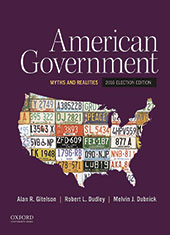
American Government: Myths & Realities (Gitelson et al): Chapters 1- 6 & 10
Note: To study for the quizzes, review these questions & take the pre-quizzes
While the vast majority of the quiz questions are multiple choice questions, the essay questions will mostly come from the following:
Ch. 1: Introduction:
-
Based on Roesler's lecture, discuss the three "functions" that every government must provide. How does the "who gets what" in Lasswell's definition of Politics reflect which functions different countries prioritize?
-
Watch the ideology (mini)lecture and explain the two different models of ideology (linear and EFO). Which better explains ideology in the US? (note: the Ideologies extra credit is helpful in understanding this topic -- and it's free points!)
- Explain how Harold Lasswell's definition of Politics is a reflection of choices over competing values. How does the clip (in the lecture) on the school lunch program reflect the fight over "who gets what"? How does this illustrate how our budget reflects our values? Be sure to relate this to Lasswell.
- Lasswell's definition of Politics also illustrates "how" we do things (the rules) can affect the outcome. How we try prisoners, how we count the votes, etc... Explain how this Daily Show clip on I.D. laws illustrate the impact of "how" we vote (the rules of voting) on the outcome of elections?
-
Watch the assigned segments of Episode 4 of the Harvard Justice Project: from the first 8 minutes & from 33:00 to 51:45 minutes--especially from 33 to 45 & 49-52 minutes). Note: The clips are also available in Canvas or you can try this one. Based on the clip, explain Locke's views of social contract, property, taxing and collective consent. According to Locke, can government force you to pay taxes? Be drafted to fight a war?
Ch. 2: The Constitution
- List two weaknesses (problems) of the Articles of Confederation? How did the Constitution address those?
- Distinguish between a Federal, Confederate, and Unitary system of government (discussed further in chapter 3).
- Discuss the main thrust of the Federalist #10 and of #51. Differentiate between the two types of democracy (direct & indirect) that Madison discusses in the Federalist Papers. Why did Madison (and the other founders) want change (passing laws) to be difficult?
- Explain Madison's arguments on how an indirect democracy would prevent a single faction from controlling the government. How would it prevent tyranny of the majority? After the 2016 election, the Republican Party controlled the House, Senate, the Presidency and the Supreme Court. Does this fit with what Madison argued in the Federalist Papers?
- What was the most democratic part of the government as originally designed? Why did the framers originally create the unusual process for choosing Senators (since changed) and the President (essentially unchanged)? Why weren't these processes more democratic?
- Outline the basic tenets of the Great Compromise (CT Plan), including the duties and powers of each branch. Be sure to look at the "Powers of Government" slide on the online lecture).
- Using the McCulloch v MD ruling, explain why Congress can create a bank. Be sure to discuss the necessary & proper clause, the implied powers doctrine and the Supreme Court's interpretation of "necessary". (we'll discuss this more in chapter 3)
- Briefly explain the importance of Marbury v Madison on the Court's power of Judicial Review (we'll discuss this more in the Courts chapter). For a good discussion/explanation of this power, watch the Colbert interview of Cliff Sloan. We will discuss this again when we cover the Courts.
- What are the two ways to Propose & the two ways to Ratify amendments to the Constitution?
Ch. 3: Federalism
- Repeat of a question from chapter 2: Explain the elastic (necessary & proper) clause and the impact of McCulloch v Maryland on the power of the national government. Explain why Congress can create a bank.
- Discuss the following three eras of Vertical Federalism: Dual, Cooperative, and New (your text refers to it as "conflicted") Federalism. According to Roesler, why is Welfare reform a good example of New/Conflicted federalism?
- Discuss the three ways in which the national government increased leverage (extended its reach) over the states (the commerce clause, grants, & incorporation/nationalization of the bill of rights (also see ch 4)).
- Explain the impact of Gibbons v Ogden. In the NLRB v Jones Laughlin Steel Company ruling, the Supreme Court ruled that companies involved in manufacturing are engaged in interstate commerce. Why is this significant for the growth of national power?
- Discuss one or two of the following issues and explain which level(s) of government currently sets policy for that issue: immigration, gun control, drinking age, marijuana/drug laws, gay marriage, or teaching curriculum.
- Explain how having a federal system affects the debate over the role of government and the debate beween equal treatment for everyone and states as laboratories of democracy.
- The textbook discusses how the Bill of Rights was originally aimed at limiting the power of the national government (note the first word of the 1st Amendment). Explain the "revolutionary" impact of the 14th Amendment’s Due Process clause and the concept of selective incorporation (if selective incorporation is confusing, you can read more about it in the Civil Liberties chapter). For more explanation, this Daily Show interview of Richard Beeman on states rights would be very helpful. Note: go here for an alternative link to the Beeman interview (starting at 3:10) if the first link doesn't work.
- Discuss the benefits or drawbacks of federalism with regards to either Medicaid coverage OR Legalized Marijuana. Is it beneficial or harmful to have such a wide variety of state laws on these topics? Note: there's no right answer, but you need to explain why you prefer different state laws or why you would prefer one single standard. How does this relate to the tension between liberty and equality?
Ch. 4: Civil Liberties
| “The Inquisition….” | Christian Science Monitor, 8/28/2003 | Susan Dunn |
- When is prayer in school constitutional? Why can't the government prevent students from praying (on their own time) at public schools?
- In 1954, in response to the threat of godless communists, the US added the words "under God” to the pledge of allegiance. Based on other court rulings, do you think it is constitutional?
- When can speech be limited? Distinguish between political speech and the less-protected (conditionally protected) speech. Give examples of each.
- Why is a free press important to democracy? Would President Trump win a lawsuit against the press over stories of sexual assault on numerous women?
- OPTIONAL readings & clips to learn more about how other countries treat defamation.
- Optional: Palast: "The Truth Buried Alive"). Google version of the Palast reading, if you have trouble with the other.
- Optional: Christian Science Monitor article (Throwing our judicial junk...)
- OPTIONAL clip on the Royal Wedding and this OPTIONAL one about Prince Charles' rumored gay relationship are helpful in understanding the difference between freedom of the press in the US and UK -- be warned, they are CRUDE, since Stewart makes fun of British limits on the press.
- OPTIONAL NPR interview of British sports writer on being sued by Lance Armstrong might also be helpful in understanding British libel laws.
- What does the 2nd Amendment mean? Discuss the debate over what the framers intended as well as the 2008 Surpreme Court ruling DC v Heller. Watch this Colbert clip on Obama's proposals to limit access to guns and this one on the meaning of the 2nd Amendment. Some argue that the 2nd amendment was designed to allow Americans to fight & kill American soldiers under a tyrannical dictator. Based on the text & lecture, do you think that the framers would want average US citizens should have the right to have Aircraft carriers, tanks, or anti-aircraft guns?
- How does the 2010 McDonald v. City of Chicago ruling illustrate "selective incorporation" of the Bill of Rights? You may want to review the ch3 lecture, where I discuss Barron v Baltimore & the impact of the 14th Amendment.
- How does Locke's concern with "arbitrary taking" of rights relate to Civil Liberties. Why is important for everyone to have the right to a lawyer, a fair trial...? Discuss the significance of Due Process, such as the exclusionary rule, in criminal investigations and in protecting the innocent from the arbitrary power of the state.
- Watch War, Freedom & Democratic Values clip in Canvas. Explain the Bush administration's "paradigm shift" (specifically, explain Brad Berenson's argument) and Tom Ridge's views on giving up civil liberties. Given that the "War on Terror" will last decades, if not longer, do you think civil liberties should be limited? For a more humorous look at the problem of "too many dots," watch this Daily Show clip (This is Wire Tap).
- Watch the first two minutes of this Colbert clip on the NSA. According to the study, how many terror attacks were stopped by the NSA reading our emails and collecting our data? What would Ben Franklin argue about this? What is Colbert's point when he asks "Does violating everyone's privacy really that bad if it doesn't even work?"
- Watch this Colbert interview of Anthony Romero, executive director of the ACLU. Do you think the President has the constitutional authority to order the assassination of American citizens (not in battle) without a trial? For an (optional) updated discussion of the drone strikes against Americans (without Due Process), watch this Daily Show clip and this one making fun of Obama's lack of transparency.
- Ben Franklin argues that "They that can give up essential liberty to obtain a little temporary safety deserve neither liberty nor safety." What does Franklin mean? Edward Snowden revealed that both Bush and Obama had lied to Americans about how much the government (NSA) was spying on Americans. Watch this John Oliver clip on the NSA surveillance program from 2:00 to 13:00 and from 25:00 to 32:00. Starting at the 25 minute mark, Edward Snowden reveals that the NSA keeps copies of much of our digital communication, including pics of our "junk." Would Ben Franklin approve of this program? In other words, based on the lecture, readings and clip, do you think the NSA surveillance program took away "essential liberty"? Did it provide real or only "temporary" safety?
- What is the constitutional basis for the right to Privacy? Explain the development of the Right to Privacy since its inception as well as what is (and is not) covered under this right. Be sure to discuss Griswold v CT, Roe v Wade, and Lawrence v Texas.
Useful (but not required) Civil Liberties links:
John Oliver on the NSA Surveillance program -- Interview of Snowden
Daily Show: Free Speech Zone
Silly Daily Show clip on Executions: http://www.thedailyshow.com/video/index.jhtml?videoId=106310&title=whaaaa
Interesting Christian Science Monitor article on the DC v Heller (2nd Amendment) ruling
Watch this Colbert clip for a fun look at relevant SC rulings in 2009.
Chapter 5
-
Differentiate between Civil Rights and Civil Liberties.
-
For a fun look at modern civil rights concerns, watch this Larry Wilmore clip on Civil War re-enactments.
-
Understand the history of disenfranchisement for minorities and the suffrage movements for blacks and women. Be aware of economic (redlining, pay, hiring...) as well as political discrimination (lack of voting rights). For info on Historic sites, go here
-
Discuss the shift in the Supreme Court rulings from the Plessy decision to the Brown decision.
-
Discuss the importance of both the 1964 Civil Rights Act and the 1965 Voting Rights Act (including voter registration rates).
-
Watch the clip on the gender gap on college campuses in Canvas and this NPR clip. Do you agree that diversity is important in the classroom and workplace?
-
Distinguish between de jure and de facto segregation. Which is harder to eliminate?
-
Go to this article on Traffic Stops (you can also find the article in Canvas). Also go to Table 1 of the executive summary of the findings (2017) and compare the "search rate" and "contraband hit rate" between whites, blacks & hispanics. According to the facts from the study, which group is most likely to be carrying drugs or other illegal contraband? Which group is pulled over and searched the most? Compare this data with the "Stop and Frisk" approach in NY City (see the chart in the lecture).
- Optional: The 2015 data was released in June of 2016 and can be found here: https://ago.mo.gov/home/vehicle-stops-report/2015-executive-summary
-
Optional: For more on racial profiling, watch this Daily Show clip on Stop & Frisk Profiling in New York City & elsewhere Note that the judge ruled the policy (as had been implemented) to be unconstitutional.
-
Optional: watch this Daily Show clip on the Zimmerman verdict and read this NY Times article by Charles Blow or go here for an alternative link).
-
Discuss two recent instances discussed in the lecture that have contributed to the creation of the Black Lives Matter movement.
- Based on all we've discussed in this unit, give evidence (from lectures, clips &/or readings) to illustrate why Civil Rights are still relevant today. After the killings of Michael Brown and other blacks by law enforcement in the past two years, many argue that the way police treat blacks is "arbitrary." Locke argued that legitimate government's can't arbitrarily take freedoms/rights. Since blacks and Hispanics are stopped at disproportional rate, but they are not more likely to be criminals, is this singling out "arbitrary?" Is that violation of their natural rights?
-
-
What is affirmative action and when can it be used (specifically, when is it unconstitutional)? Be sure you can explain the Bakke and the 2003 Michigan rulings. If you're interested, you can read this OPTIONAL analysis of the June 2013 Supreme Court ruling.
- From the Admissions Response Discussion assignment, list one or two criteria that were most important to you. Did everyone agree with you on what is the most important criteria or the "best" candidate? If not, then there isn't an "objective" measurement of the "best" candidate. How would this relate to using Affirmative Action to hire/promote minority workers/students who are roughly equally qualified since different people could argue one or the other would be "more qualified"?
Optional clips:
Chapter 6
- Briefly discuss 2 characteristics of American Political Culture that is distinct from other democracies (guns, mistrust of government, work ethic...).
- Discuss problems of opinion polling that effect the validity of polls, such as push polls and poor sampling.
- Optional: For a fun look at polling, watch Colbert interview pollster Scott Rassmussen and this Daily Show clip on polling distortions. For more on Push Polling, watch Colbert as he makes fun of Push Polling in the 2008 Republican primary against John McCain.
- Optional: June 2013 Poll Americans on Foreign Policy, Obama’s Efficacy and Same-Sex Marriage
- How a question is asked can garner differing results. Why can results differ based on word choice?
- Repeat question: Explain the two different models of ideology (linear and EFO). Which better explains ideology in the US? If you're unsure about this, re-watch the ideology lecture (for ch1) and/or do the Ideology Extra Credit.
- Discuss the importance of key agents of political socialization: family, schools, peers and the media. Which is the most important in shaping long-term attitudes?
- How do demographics (religion, race, age & gender) affect politics & voting behavior?
- People (of all persuasions) believe education is so important that they manipulate what's in the curriculum for their own agenda. Give an example of ways public schools try to socialize us, based on the text and/OR this Colbert clip on politics and education
Optional: For more, here's a silly clip that discusses parties & socialization for children: daily show: One State two state
Chapters 10 : The Media & Politics
also read this Newsweek article: The Fiction Behind Torture Policy -- 8/4/2008; p11 by Dahlia Lithwick (alternative link to Lithwick article)
- Discuss the history of media in politics, including yellow journalism, Fireside Chats and media segmentation. Be familiar with agenda setting (or priming).
- Explain the recent trends of Convergence & Consolidation.
- Read the Lithwick article on the show "24" from Newsweek (I also put a link to an image file in Canvas under the current unit). What is the main point of the Newsweek article? Discuss the impact of television on Americans' fears and support for expanded police powers. Why is there a difference between those who get their news from television and those who read the newspaper?
- While most Americans believe that the media has an ideological bias, Roesler & the text argue that corporate bias is more important in coverage, since the media is usually a for-profit business. How does corporate bias explain the media's focus on sensationalism? How does it explain the massive amounts of free media Donald Trump received in the 2016 campaign? Be sure to use CBS president Les Moonves' quote in your answer.
- Why does Jon Stewart argue that the media is like 6-year-olds playing soccer and like the Dog from Up (the clip is in the lecture, but you can watch the entire clip here)?
- How much impact does the media have on Socialization? Give one example from Roesler's lecture of how the media has shaped our opinion on an issue.
- Read this article on media violence and explain the link between violent media and violent behavior. Watch this Daily Show clip on the 2011 Supreme Court ruling on Media violence. Explain the Supreme Court ruling on California's attempt to ban violent video games from being sold to children. According to the ruling, can the government limit sexual content and/or violent content? Do you agree with the ruling limiting one but not the other?
- For more (optional), you can read this summary of this case or read about the actual ruling here (or here).
- What medium does President Trump use to communicate directly with voters?
- Discuss the prominence of Fake News in the 2016 election. How did Cambridge Analytica use private information from Facebook and other social media to target small number of social media uses with pizzagate and other "fake news"?
- Why does "fact-checking" sometimes backfire?
Possible Essay Questions on the Midterm MAY cover some of the following topics:
Locke -- taxes & collective consent
The 14th Amendment --ch2 & 3
Bush's Paradigm Shift -- ch 4
California's Ban on Video Games --ch 10
Development of Federalism --ch3
Socialization -- ch 6 & 10
Lasswell & budget cuts -- ch1
Relevance of Civil Rights -- ch 5
Prayer in Public Schools -- ch 4
Right to Privacy-- ch 4
Cases to Know for this class (most should have been covered in the previous questions)
McCulloch v. Maryland
Marbury v. Madison
Barron v. Baltimore
Gibbons v Ogden
Schenk v. US (Clear & Present Danger)
NY Times & Wash Post v. US (Pentagon Papers case)
DC v Heller
Griswold v. Connecticut
Roe v. Wade
Regents of the Univ of CA v Bakke
Brown v Board of Education
Plessy v Ferguson

4601 Mid Rivers Mall Drive
Cottleville, MO 63376
636-922-8000